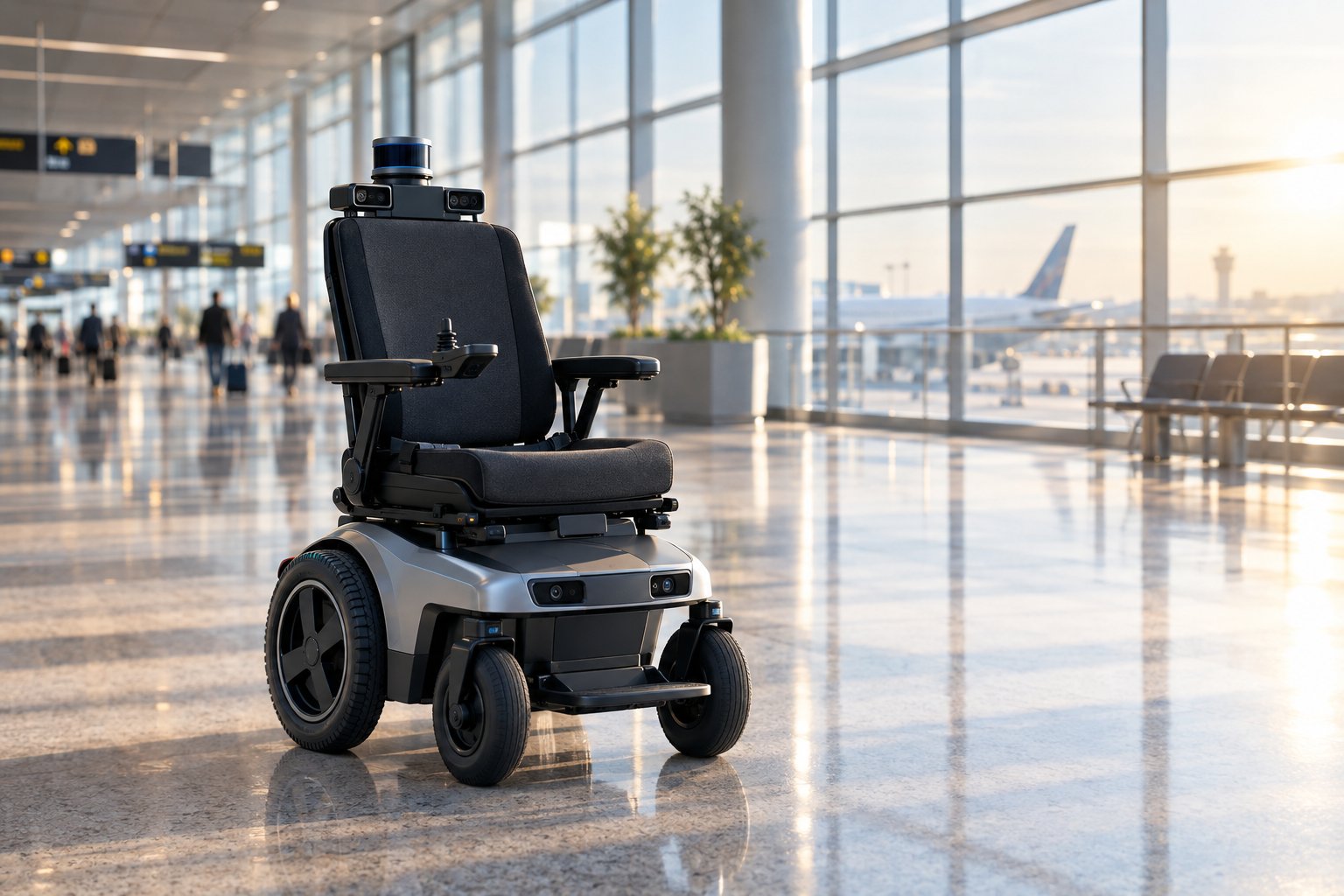
Tugend's flagship platform was demonstrated live at BWI Airport, navigating from Door 8 on the upper terminal level, to the ticket counter, and through security checkpoint C. The system is built on FDA-cleared Group 2/3 power-mobility hardware and is reimbursable under existing CMS coverage.
The platform is built on an FDA-cleared Group 2/3 powered wheelchair chassis, which means the device is reimbursable under existing Medicare coverage — no new code or pathway required.
Result: a defined, established reimbursement route into the >$1B/yr CMS power-mobility category — a material de-risking factor for clinical, payer, and investor diligence.
The core autonomy stack was co-developed at Morgan State University across three research centers:
MSU License Agreement fully executed 30 April 2026. Patent issued via USPTO. Co-Principal Investigators: Dr. Mansoureh Jeihani (NTC / SMARTER) and Dr. Kofi Nyarko (CEAMLS).
The chair meets the passenger where they are — no reservation queue, no staff dispatcher, no waiting for a human escort.
The passenger scans a QR code from a designated area of the terminal. The mobile app opens; they register once, or log in if they have used the system before.
The wheelchair drives itself to the passenger's location. Before the ride begins, the system verifies that the person boarding is the person who summoned it — informed consent, established explicitly.
The passenger sits, enters their destination in the app, and the wheelchair navigates them there autonomously along a guided path at 2.5–4 mph — the speed of walking foot traffic.
The platform is designed to move confidently through the kinds of public buildings where independent navigation is currently hardest.
"Today's demonstration is a significant step towards making public transportation more accessible for everyone. We believe integrating technology into mobility solutions can empower individuals, enabling them to navigate public spaces with ease and confidence." — President David K. Wilson, Morgan State University
"It's about meeting real needs, removing real barriers, and ensuring that everyone — regardless of ability, age, and background — can move through the world freely." — Lt. Governor Aruna Miller, State of Maryland
"Our team wanted to combine the most cutting-edge AI and computer vision technologies with sensible wheelchair design choices. Giving people with disabilities this kind of mobility and independence makes public spaces much more inclusive." — Dr. Mansoureh Jeihani, Co-Principal Investigator, Morgan State University
Full press coverage: Morgan State University News — "Morgan Showcases Autonomous Wheelchair at BWI Airport" ↗